


Protecting the Critical Work Zone During Sterile Compounding
How Baker’s EdgeGARD® Rx uses high-velocity return air slots to help control airflow disturbances during real-world pharmacy work.
In sterile compounding, clean air is essential. But a laminar flow clean bench does not operate empty.
Pharmacy technicians introduce hands, syringes, vials, equipment, and other objects into the work area – each capable of disrupting otherwise uniform horizontal airflow. That is a challenge Baker has been studying for decades, and one that helped shape the airflow design of the EdgeGARD® Rx Horizontal Flow Clean Bench.
EdgeGARD® Rx is optimally configured for non-hazardous sterile compounding and USP <797> applications. At the heart of its airflow design are Baker’s high-velocity return air slots along the front of the work surface and sidewalls. To understand why they matter, it helps to look at what happens when clean airflow encounters in the real world.
When Laminar Airflow Meet Real World Workflows
Horizontal laminar flow clean benches deliver HEPA-filtered air across the work surface toward the operator. Under ideal conditions, that directional airflow provides the clean environment needed for critical compounding activities.
But real-world conditions are not ideal. When hands, containers, or equipment interrupt horizontal airflow, they can create turbulent wakes and low-pressure regions downstream. Those disturbances can allow room air to move back toward the work zone.
Traditional clean bench testing is often performed with an empty cabinet. Baker wanted to understand what happens when equipment and people are actually present inside the hood.
Baker’s Approach: High-Velocity Return Air Slots
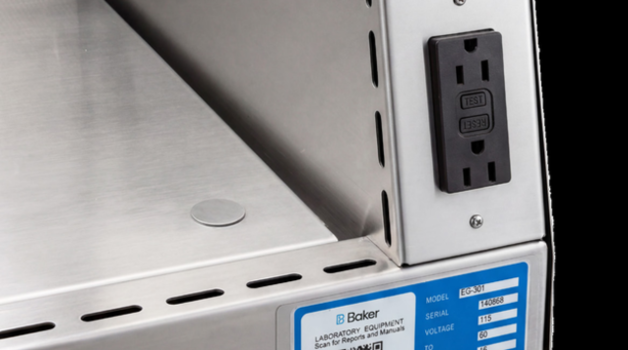
EdgeGARD® Rx uses high-velocity return air slots positioned along the front edge of the work surface and the sidewalls. Rather than relying solely on the primary horizontal airflow, the slots capture disturbed air at the boundary regions where backwash can occur.
This helps collapse the low-pressure zone created behind an obstruction and re-establish directional control of the primary horizontal flow – helping prevent room air from being drawn back into the critical work area.
The horizontal airflow delivers clean air. The return air slots help keep disturbances from bringing room air back with them.
Seeing the Difference
The effect is easy to demonstrate visually. In Baker’s airflow demonstration, the return air slots are temporarily blocked to simulate a conventional horizontal laminar flow clean bench. Smoke introduced near an obstruction can be seen moving back toward the work area. When the EdgeGARD return air slots are functioning, the disturbed air is instead captured at the perimeter.
The demonstration illustrates why airflow performance during actual use matters – not simply airflow performance in an empty cabinet.
Testing Beyond the Empty Hood
Baker has also evaluated the concept using comparative particle-count testing. In the study, an EdgeGARD® Rx was converted to behave like a conventional horizontal laminar flow cabinet by sealing the return air slots and readjusting the primary airflow to the same average velocity. The two configurations were then evaluated empty, with equipment installed, and with an operator actively working.
The most meaningful differences appeared when airflow was interrupted. With a microscope installed in the work area, the EdgeGARD® Rx configuration maintained substantially lower particle counts than the same cabinet operated with its return air slots blocked. Testing with an operator actively working also showed lower particle counts with the EdgeGARD® Rx airflow design.
The historical study used the clean-air classification standards available at the time, but the engineering lesson remains relevant: clean bench performance should be considered under realistic working conditions, not only when the work zone is empty.
Designed for the Way Pharmacy Actually Works
High-velocity return air slots are part of the airflow design behind EdgeGARD® Rx, Baker’s horizontal laminar flow clean bench optimally configured for non-hazardous sterile compounding and USP <797> applications.
EdgeGARD® Rx combines Baker’s proven airflow technology with pharmacy-focused features selected for the demands of sterile compounding. And while thoughtful engineering can help maintain a clean work zone, proper aseptic technique remains essential; Baker recommends locating critical operations at least 6 inches from the front of the work surface to gain the full benefit of the protected work area.
Because in the pharmacy, the question is not simply whether a hood can provide clean air. It is how well that clean environment is maintained while the work is being done.
Learn more about EdgeGARD® Rx