


By Jason Dollarhide
Modern healthcare infrastructure requires an unprecedented level of environmental control, particularly within pharmaceutical compounding environments. The United States Pharmacopeia (USP) enforces rigorous standards to ensure the safety of both patients and healthcare workers. USP Chapter <797> governs the preparation of sterile medications to prevent microbial contamination, while USP Chapter <800> regulates the handling of hazardous drugs (HDs) to minimize personnel exposure risks. Meeting these dual requirements simultaneously demands highly sophisticated architectural and mechanical engineering.
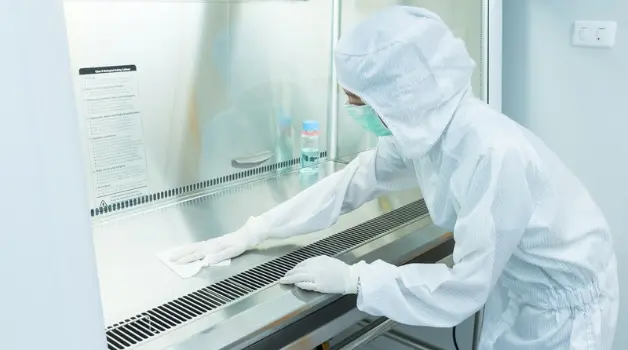
Traditionally, facilities relied on conventional “stick-built” construction. However, the rise of modular cleanroom construction has emerged as a better practice and afforded greater reliability for the pharmacy staff. Prefabricated modular engineering offers advantages over traditional construction by ensuring structural precision, minimizing hospital operational downtime, and providing ease, speed, and efficiency in cleaning and decontamination.
To appreciate the value of modular building, one must first understand the complex, conflicting engineering physics mandated by USP guidelines. USP <797> environments require an ISO Class 7 buffer room maintained under positive differential pressure to prevent outside contaminants from entering the sterile compounding zone. Conversely, USP <800> mandates negative differential pressure and external exhaust ventilation to ensure that toxic, carcinogenic, or mutagenic hazardous drug particles do not escape into adjacent hospital corridors.
A compliant pharmacy design must seamlessly integrate these two disparate systems, often utilizing a shared anteroom as a transition point. Achieving these precise pressure cascades requires perfectly sealed envelopes, advanced HVAC design, low-wall return air systems, environmental monitoring, and specialized interlocking pass-through cabinets and interlocked entries.
Traditional construction introduces predictable liabilities into a healthcare facility. First and foremost is the threat of contamination. Standard drywall installation generates large volumes of gypsum dust, posing a severe threat to nearby sterile pharmacy environments. Furthermore, field-applied epoxy finishes are prone to cracking over time due to building settlement and chemical degradation from harsh daily cleaning agents (such as isopropyl alcohol and bleach). Repairs can be problematic because they require patching, sanding, and painting, which ultimately necessitate a shutdown, recleaning, and recertification of the space. Any downtime costs money.
Modular construction mitigates these risks by shifting the fabrication process from the chaotic construction site to a controlled factory environment. Prefabricated wall panels are manufactured to exact measured tolerances. These materials are non-shedding, non-porous, and chemically resistant, enabling them to withstand aggressive decontamination protocols without degrading. The properly selected system will be a progressive system with a seamless wall connection that is either cold-welded or silicone sealed. Modular systems feature integrated, factory-molded coved corners and flush-mount ceiling systems. This eliminates 90° joints and other trap points where particulate matter collects. The airtight interlocking systems ensure that the strict positive/negative pressure boundaries required by USP <797> and <800> are strictly maintained. And many systems allow the panels to be used as return air plenums, reducing ductwork and even removing return air grills from the build-out by placing balancing dampers outside the cleanroom.
By choosing a modular approach, healthcare systems do not just purchase walls and HVAC ducts; they invest in a predictable, high-performance cleanroom environment. This strategic choice safeguards patient health, protects frontline compounding technicians, and future-proofs the pharmacy against tomorrow’s regulatory shifts.