


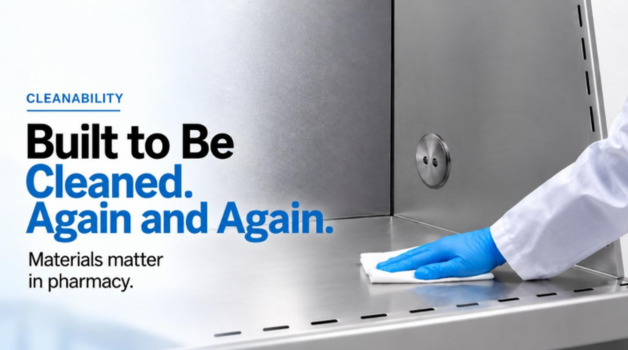
Sterile compounding demands rigorous cleaning and disinfection. But the disinfectant selected to protect a critical work environment also comes into repeated contact with the surfaces of the primary engineering control itself.
And not every disinfectant and surface are equally compatible.
Repeated exposure to incompatible chemicals can stain, discolor, pit, or corrode stainless steel. Over time, that can leave behind a surface that is harder to clean – the opposite of what the cleaning process is intended to accomplish.
Can Any Chemical Disinfectant be Used in a BSC?
Baker’s BSC MythBusters program tests common assumptions about biosafety cabinet use against available evidence. One of those assumptions is that any chemical disinfectant is appropriate simply because a cabinet is constructed from stainless steel. The reality is more nuanced: compatibility depends on the chemical, concentration, exposure, rinsing practices, and the grade of stainless steel.
Chemical disinfectant compatibility with stainless steel
Not All Stainless Steel Responds the Same Way
Stainless steel is often treated as a single material, but grade matters. Baker’s published chemical-compatibility chart shows that 304 and 316 stainless steel respond differently to several disinfectants commonly encountered in pharmacy environments. Examples include citric acid, DECON-QUAT®, Vesphene Environ®, LpH® III, Ecolab® disinfectant cleaner and quaternary ammonium compounds, all of which receive a more favorable rating for 316 stainless steel in Baker’s reference chart.
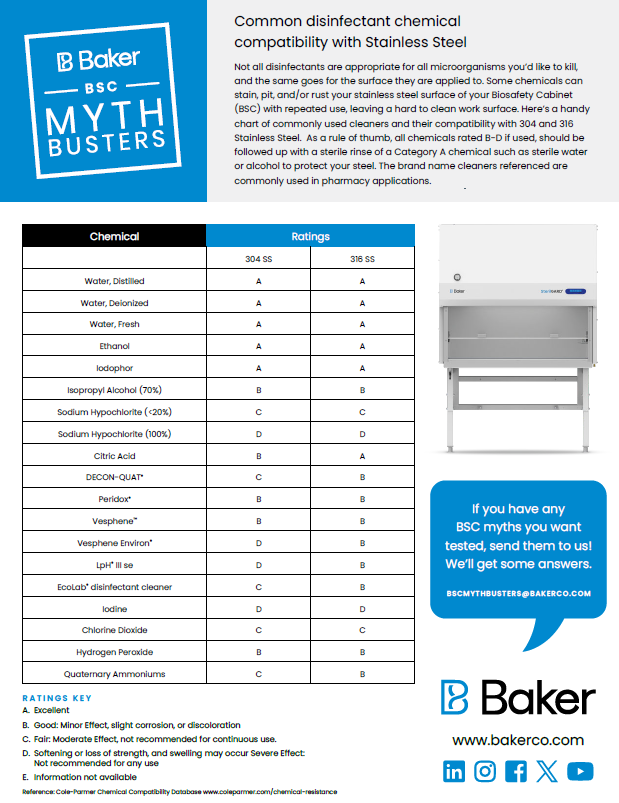
Baker BSC MythBusters compares common disinfectants and their compatibility with 304 and 316 stainless steel.
316 Stainless Steel is Not Invincible
A higher grade of stainless steel does not eliminate the need for proper chemical selection and cleaning technique. Baker’s compatibility resource shows that some agents remain challenging for both 304 and 316 stainless steel. The resource recommends that chemicals rated B through D, when used, be followed after the required contact time by an appropriate sterile rinse with a Category A material such as sterile water or alcohol to help protect the steel.
Cleanability Starts with the Cabinet
Cleaning practices matter. So does the environment being cleaned. Baker Rx configurations are designed with the repeated cleaning demands of pharmacy compounding in mind.
- 316 stainless steel interiors: provide greater chemical and corrosion resistance than the 304 stainless steel used in standard Baker interiors for several commonly used cleaners and disinfectants.
- 304 stainless steel exteriors: replace the powder-coated cold-rolled-steel exterior used on standard configurations, improving material resistance on exterior surfaces that may also be routinely cleaned.
- Smooth interior sidewalls: remove unnecessary plumbing fixtures, electrical outlets, and petcocks from the work zone, reducing obstacles and interfaces that require cleaning.
- Stainless steel cable ports: provide durable, cleanable routing for workflow equipment while helping preserve an accessible work area.
The goal is not a cabinet that is immune to every disinfectant. Proper chemistry, concentration, contact time, rinsing, and pharmacy cleaning procedures still matter. The goal is to begin with materials and interior geometry selected for the environment in which the cabinet will actually be used.
Proven Engineering. Optimized for Pharmacy.
Baker Rx applies proven Baker engineering to pharmacy-focused configurations designed around how sterile compounding environments are cleaned, maintained, and used.