


Operations Director
~ ACORx
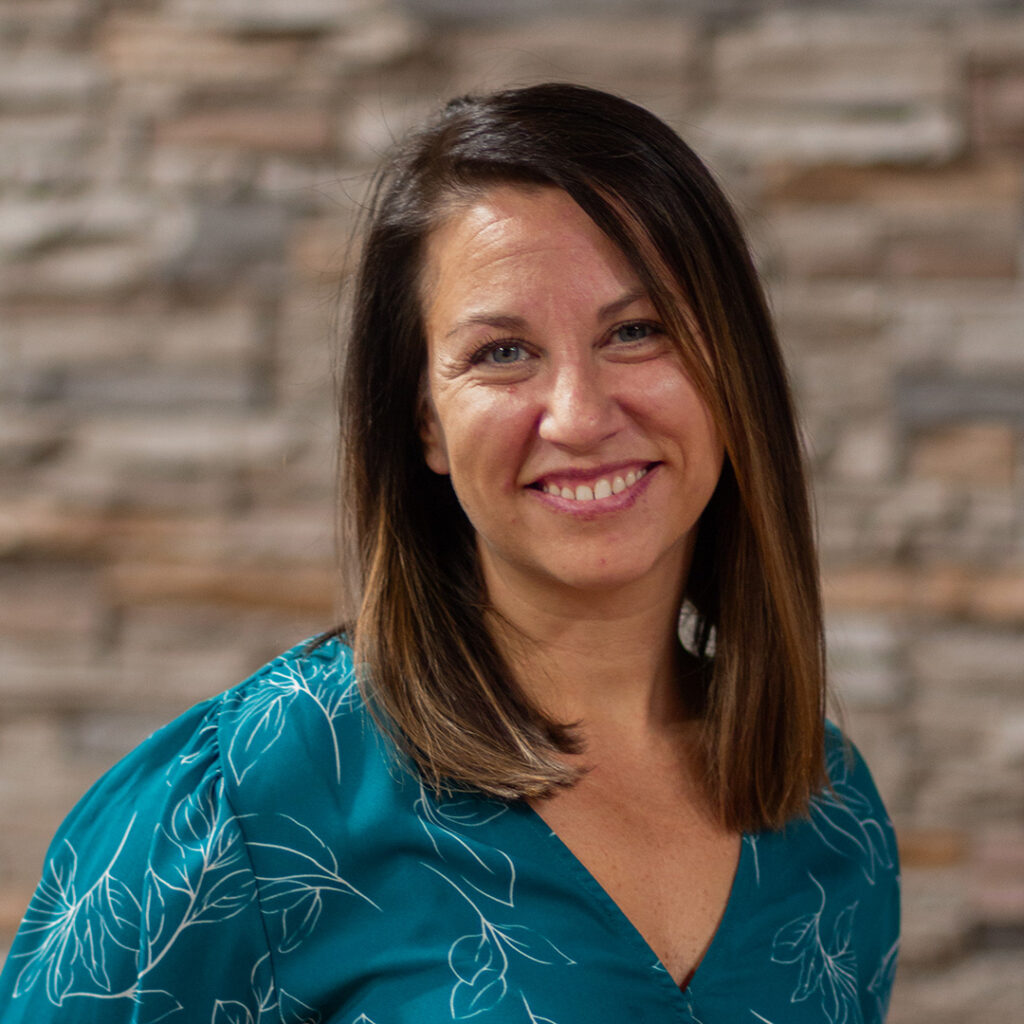
Amy Karlek, PharmD, is Operations Director at ACORx. She brings LTC, community, and psychiatric care experience to her role. Amy also precepts pharmacy students and mentors tech school students.
Pharmacies across retail, combo-shop, and long-term care face familiar pressures: shrinking reimbursement, staffing shortages, and increasingly complex patients. What’s changed is the urgency to scale operations without scaling costs. ACORx, a closed-door LTC pharmacy in Carnegie, Pennsylvania specializing in Long-Term Care at Home, has spent the past decade building exactly that kind of model — offering a practical blueprint for how LTC At Home pharmacies can grow sustainably.
THE CHALLENGE: FINDING A PATH TO SCALABLE GROWTH
While ACORx is expanding its footprint by serving traditional LTC facilities and adding new partner communities, the pharmacy is quickly outpacing its competitors in LTC At Home. ACORx coordinates complex medication regimens for patients who require LTC-level support but prefer to remain in their homes. Serving patients across six counties in the greater Pittsburgh region, the pharmacy acts as a critical link among physicians, health plans, caregivers, and families.
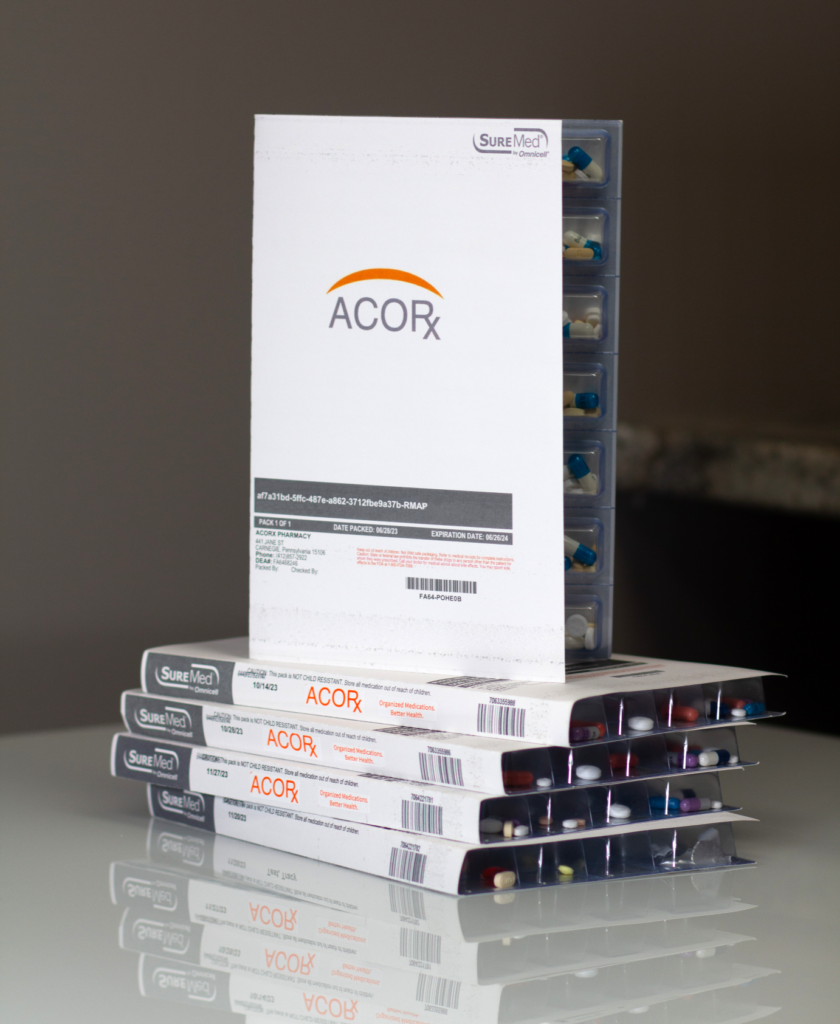
Most patients take an average of 12 medications, typically organized into multi-dose blister cards that group medications by administration time. Blister packaging simplifies complex regimens and improves adherence, helping patients safely manage their medications at home.
For years, ACORx produced those blister cards entirely by hand. As the pharmacy scaled from a few hundred patients in the early 2020s, the limits of that process became increasingly clear. Each card required technicians to fill individual blisters manually, followed by a pharmacist reviewing each blister one by one.
The workflow created several operational challenges:
- Labor-intensive production: Each blister card was filled dose-by-dose by a technician.
- Extensive pharmacist verification: Complex orders could require up to 10 minutes of pharmacist review.
- High correction rates: Technicians averaged corrections on three of every eight cards (37%).
- Staff fatigue: Pharmacists frequently worked overtime to keep pace with production.
“It was insane how much we were spending on overtime, and our burnout rate was rising,” said Amy Karlek, PharmD, operations director at ACORx.
THE SOLUTION: JFCRx TruCardTM BLISTER CARD PACKAGING
Manual workflows had become a barrier to growth. To scale its LTC At Home program without scaling costs, ACORx turned to TruCard from JFCRx.
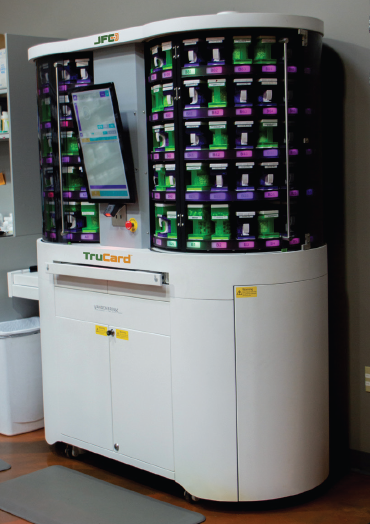
The TruCard system addresses the two critical failure points of manual blister card production: filling accuracy and verification speed. Medication canisters equipped with RFID-smart technology allow continuous production without interrupting the line to swap or reload, and the guided prefill station uses fill-to-light technology to reduce errors on non-canister medications.
Once filled, every blister cup is photographed and inspected by the system’s onboard vision technology, which verifies each cell against a medication algorithm based on quantity, pill size, shape, and color. The system flags only true exceptions for pharmacist review, replacing the exhausting blister-by-blister visual check with a streamlined exception-based workflow. Every image is stored in a complete audit trail, available for future reference during counseling, generic changes, or caregiver inquiries.
Implementation required training ACORx staff on the new workflow and integrating the system into ACORx’s existing production rhythm. JFCRx’s support team maintained a continuous presence through that transition and has remained a responsive operational partner since.
“JFCRx’s support team is the fastest I’ve experienced in healthcare,” says Karlek. “We’re never down with them — and that’s huge.”
The overnight impact on pharmacist experience was perhaps the most immediate transformation.
“Our pharmacist can inspect 40 cards in a row from TruCard and nothing’s incorrect — versus manual, [where] a pharmacist might be able to inspect eight cards and three of those cards needed fixes,” Karlek says.
THE RESULTS: MEASURABLE GAINS IN EFFICIENCY AND CAPACITY
- Since installing TruCard, ACORx grew from 300 patients to approximately 2,600 — a 767% increase — while adding only one weekday operating hour and two hours on Saturdays.
- Roughly 70% of patient medications are now fully automated through canister dispensing, with 1.5 technicians running the production line across an eight-hour shift.
- The system consistently completes seven to eight patient orders per hour, equivalent to up to 32 filled and verified cards per hour.
- Pharmacist verification time dropped 75% from its previous average of 2.5 minutes per card, enabled by the vision system’s exception-based flagging rather than manual inspection.
- Error rates on completed runs fell to near zero (despite LTC At Home patients taking an average of 12 medications).
- Zero turnover among pharmacists.
“I have five full-time pharmacists right now doing an amazing job of conducting clinical reviews and product checks for 2,600 patients,” says Karlek. “If I didn’t have the TruCard machine and everything was manual, I would probably need two more pharmacists and six more technicians. Also consider just the mental health aspect — I would have a much higher turnover rate of both pharmacists and techs. I haven’t lost anyone since TruCard got here,” Karlek says.
SIMPLIFYING MEDICATION MANAGEMENT FOR PATIENTS AND CAREGIVERS
For LTC At Home patients — whose medications are often managed by family members — the TruCard multi-dose blister cards provide a simple way to keep complex regimens organized.
“I’ve even had LTC At Home patients switch to us from pharmacies using other packaging,” Karlek says. “It’s incredibly easy to explain how to use TruCard packaging.”
A SIGNIFICANT FINANCIAL IMPACT
Operational efficiencies created by TruCard allowed ACORx to reinvest savings into a dedicated clinical services team, funded at roughly $250,000 annually. The team focuses on clinical review and patient care rather than dispensing.
ACORx also retains significant capacity for growth. The pharmacy can add several hundred additional patients — and take on more LTC contracts — without extending operating hours or increasing staffing.
POSITIONED FOR THE FUTURE OF LTC AT HOME
With the U.S. population aged 65+ projected to reach 82 million by 2050, demand for LTC At Home services will continue to rise. For many seniors, aging at home is a financial necessity rather than a choice.
The ACORx experience shows how pharmacy automation can remove operational constraints, enabling pharmacies to scale care safely while supporting growing patient demand.
“The technology is powerful, but the partnership is what makes it work,” Karlek concludes. “JFCRx listens, responds immediately, and keeps improving the TruCard system. That relationship is essential — because without a partner committed to our success, we couldn’t maximize everything this machine can do for our patients.”
For more information, visit www.JFCRx.com or (262) 729-9200.