

Contributed by Megan McCaskill, Vice President of Compliance and Strategy at Horizon Pharmacy and Chief Pharmacist for RI-1 DMAT
When disaster descends — from a hurricane, an earthquake, public health emergency, or other natural disasters — the world turns to its frontline heroes. During these major emergencies, the role of pharmacists is essential yet frequently under-recognized. Providing more than medication, pharmacists deliver stability, clinical expertise, and compassionate care amidst the most challenging circumstances. Their responsibilities include coordinating and dispensing emergency medication and supplies, advising on appropriate treatment protocols, and offering support to the affected communities. Drawing on my own experience with the U.S. Department of Health and Human Services’ National Disaster Medical System (NDMS), the following explores the profound impact we as pharmacists can make during emergencies.
Answering the Call to Serve
About a year after 9/11, I received a flyer in the mail that would shape the course of my professional life. The flyer was a recruitment call for NDMS medical personnel of all disciplines, including pharmacists. It highlighted a group called, Rhode Island-1 Disaster Medical Assistance Team (DMAT), and their response efforts during 9/11 and previous hurricanes. After attending an informational meeting, I introduced myself as a pharmacist. The immediate response from the group was overwhelming enthusiasm. The team lacked a pharmacist — an essential role for a federal team’s deployment posture. I was compelled to serve and within six months I deployed.
20 Years and Over 10 Deployments
I have served since then with the RI-1 DMAT, which is one of 40 federal medical teams of intermittent first responders located across the United States. DMATs are comprised of physicians, physician assistants (PA), nurses, paramedics, pharmacists, and other medical and support professionals. We are deployed to provide rapid response medical care, hospital support, and emergency services during disasters, major incidents, and national events.
Over the course of my time, I have deployed more than 10 times, most often in the wake of hurricanes. Each assignment has presented its own challenges and I’m proud of my team’s incredible achievements, however a few deployments remain unforgettable.
Responding to Hurricanes
In 2005, following Hurricane Katrina, our team deployed to the Superdome in New Orleans shortly after the levees failed. The situation was critical, and our mission was to provide medical care to every patient sheltered there before they could be transferred to hospitals, alternative facilities, or other shelters. Over the course of two months, I spent five weeks in Louisiana supporting multiple operations. During that time, our team established a mass vaccination clinic where we administered Hepatitis A, Hepatitis B, and tetanus-diphtheria vaccines. Additionally, we operated a special needs shelter for residents displaced from nursing homes that had been destroyed, ensuring they received continuous care in the aftermath of the disaster.
In 2017, after Hurricane Maria hit Puerto Rico, we set up a pharmacy tent next to our temporary field hospital on a pier in San Juan. We treated a wide range of acute and chronic conditions, but one of the most pressing issues was patients simply needing refills for their daily medications. With the island’s power grid down and internet access unreliable, all prescription labels were handwritten. Another distinctive aspect of this mission was living onboard the USNS Comfort, one of two Navy hospital ships. It was deployed to Puerto Rico to provide care for patients our team triaged. The ship also was our temporary home, as much of the island remained without power and few hotels were operational.
Most recently in 2024, we deployed to the mountains of North Carolina to support a local hospital following Hurricane Helene. We established our medical facility in the parking lot of a damaged hospital and supported their emergency operations. Helene’s unexpected path left unprepared communities without access to key medications. For two weeks, we filled countless maintenance prescriptions to ensure continuity of care until local pharmacies could resume operations.
What Deployment Life is Really Like
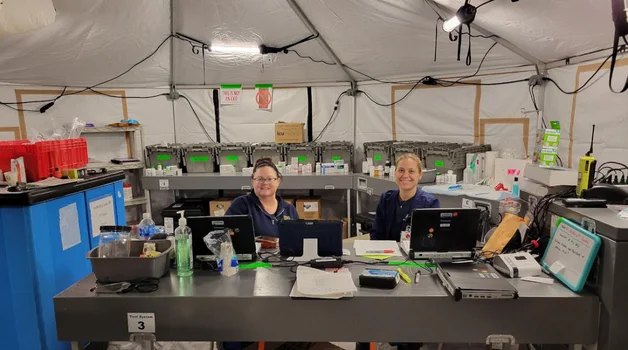
DMATs deploy to disaster sites with sufficient equipment and supplies to sustain themselves for 72 hours while providing medical care to a fixed or temporary medical care site. The team deploys for up to two weeks per mission. As the pharmacist, my role is to establish a working pharmacy in whatever space is available. While we don’t carry every medication, we provide safe substitutions until local pharmacies reopen.
People often ask where I sleep, what I eat, and how I pack for disaster deployment. My team likes to joke that disaster deployment is just “extreme camping.” We work around the clock in all climates, sleeping in shifts, usually on cots in tents or wherever space allows. I have curled up in the pharmacy more than once. Packing requires multiple uniforms, comfortable clothes, and essentials like sunscreen, bug spray, solar gear, and a bathing suit for outdoor showers. Meals are mainly Meals Ready to Eat (MREs), but I bring peanut butter, fluff, and a loaf of bread. Overall adaptability is crucial, and port-o-johns quickly become indispensable.
Harmonizing Service, Work, and Family
Balancing the immediate tasks of disaster deployment with family and work responsibilities is challenging, especially when communication is limited in remote areas. Fortunately, emergency systems provide crucial peace of mind to communicate with home. My team is on call three months a year, with two-week deployments that impact both home and work life. Support from family and friends is essential to manage daily responsibilities during these absences.
Supportive relationships, both personal and professional, are what make this work possible. While Uniformed Services Employment and Reemployment Rights Act (USERRA) offers legal protection for deployed federal responders, true support comes from an understanding and encouraging workplace and family. At Horizon Pharmacy, my deployments are met with pride, not hesitation. This motivates colleagues, inspires service, and underscores pharmacists’ crucial role in emergencies. Sustainability comes from the everyday gestures — covering a shift, checking in on my family, or simply saying, “We’ve got you. Go do what you do best.” Those small actions make a lasting impact.
How to Get Involved
Begin by creating a profile on USAJobs.gov and setting up job alerts, as positions may open and close at various times. Search for pharmacist roles within the U.S. Department of Health and Human Services, specifically under the Administration for Strategic Preparedness and Response (ASPR) and the National Disaster Medical System (NDMS). You can also follow ASPR on Facebook for the latest updates and recruitment announcements. NDMS pharmacists can practice nationwide during deployments without the need for reciprocity and are covered by federal liability protection and workers’ compensation. Employment rights are maintained under USERRA, which ensures job security and benefits following deployment.
Why I Continue to Serve
I do this work because I love it. Disaster response brings an authentic, human side to pharmacy work that goes beyond just medications — it’s about meaningful connections. Collaborating with a close-knit team and helping people in crisis gives me a sense of purpose. Meeting diverse individuals and sharing a common mission is rewarding and, while the gratitude is humbling, it is the lasting impact that matters most to me.
As Mother Teresa said, “We can’t help everyone, but everyone can help someone.” In disaster response, that is exactly what we do — one act of kindness, one patient, one moment at a time.
Disclaimer: Megan McCaskill is an intermittent health care provider with the NDMS Disaster Medical Response Team (DMAT). She developed this content in her personal view and experiences. The views expressed are her own and do not necessarily represent the opinions of HHS or the U.S. Government.